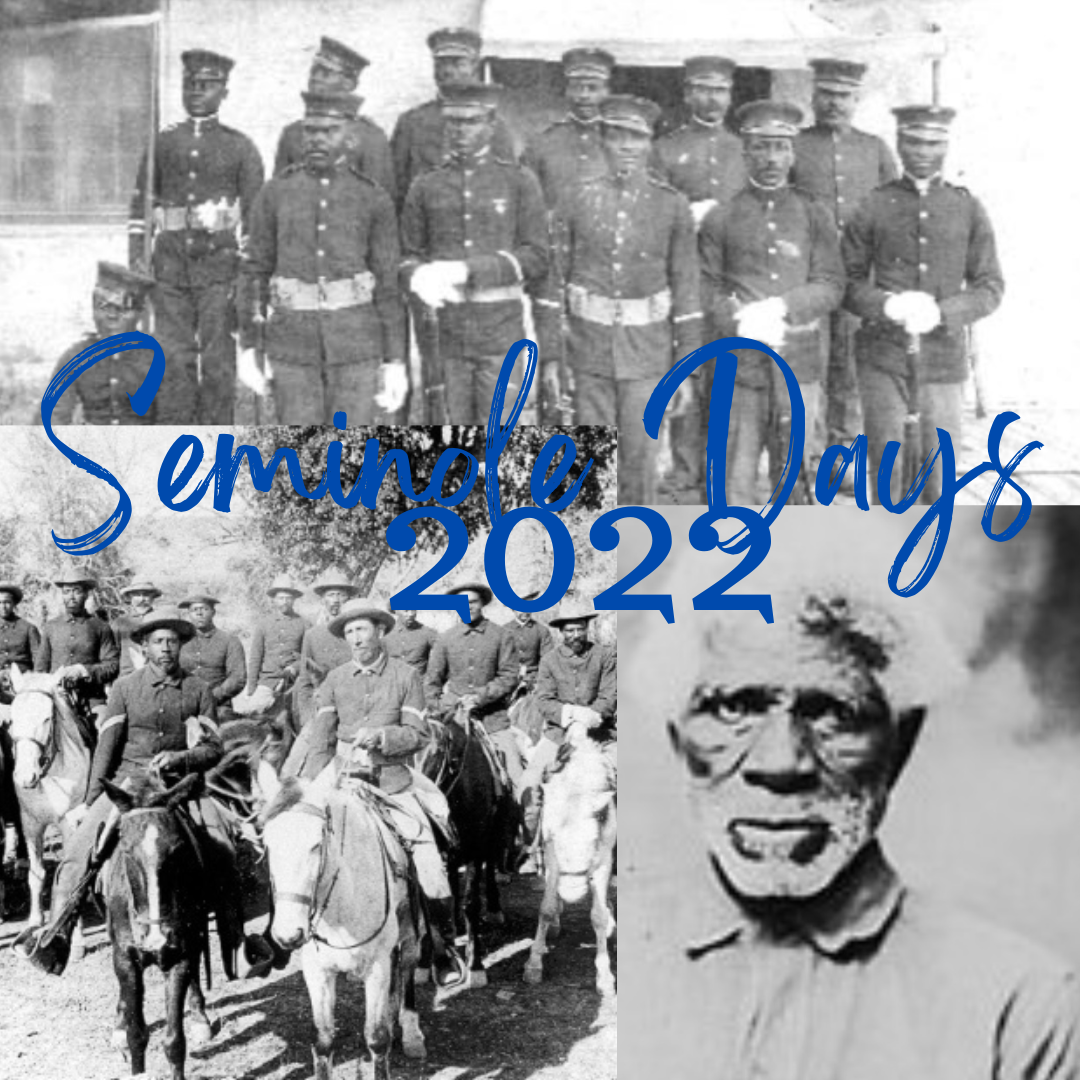
Seminole Days 2022
Seminole Days 2022
Friday, September 16, 2022 - Sunday, September 18, 2022
Friday, September 16, 2022:
Sunday, September 18, 2022:
- 7:00 AM – 10th Anniversary - Trip to Seminole Canyon (Meet at the Carver School at 6:30 AM)
- 5:00-600 PM: Afro-Seminole Creole Lesson taught by Dr. Ian Hancock
- 6:00 – 8:00 PM – Meet & Greet/Lecture Series: Tom Ashmore & C.A. Maedgen, III present Camp Meyers Spring & the Seminole Negro Indian Scout Encampment
- 8:00 AM – Breakfast with the Fort Clark Historical Society
- 10:00 AM – Parade - Marshal - Joe Louis Factor (Participants line up at Brackett ISD at 9:30 AM/ends at Carver School)
- 11:00 AM – 4:00 PM – Voting for 2022 Election/Membership Renewal (Carver School) (Voting by eligible SISCA Descendant members only)
- 11:00 AM – Annual Program
- 12:00 PM – BBQ Plate Sale begins
- 3:00 PM - Presentation by Artist Johnny Montgomery (His work will be on display the entire weekend)
- 4:00 PM - Screening of THE S.I.N.S - presented by Lovie Johnson, writer, director, and actor of the series
- 5:00 PM - Afro-Seminole Creole Lesson taught by Dr. Ian Hancock
- 6:00 PM – Annual Meeting and Election Results
- 7:00 PM – Pasta Dinner
- 8:00 PM – 12:00 AM – Dance
Sunday, September 18, 2022:
- 10:00 AM – Service at the Seminole Indian Scouts Cemetery
- 12:00 PM – Potluck Lunch (Carver School)
Trip to seminole canyon - 1oth anniverSARY
We began taking our annual trip to Seminole Canyon in 2012. Our trip to Seminole Canyon is the first event of Seminole Days. It is a perfect reminder of why we gather each year. As we hike the canyon, retracing some of the same steps that our ancestors walked, their sacrifices, tenacity, and hard work come into sharp focus. While we may be exploring the canyon in a large group, it is not hard for this walk to become a deeply emotional and personal experience.
Seminole Canyon is located about 1 hour and 10 minutes away from Brackettville in Comstock, Texas. The trip is long, but it is peaceful and scenic. We usually take our own cars or figure out a way to carpool before we form a caravan and leave the school grounds.
We recommend that you dress comfortably. Most importantly, you should wear shoes that are made for walking or hiking. You should definitely bring water (or a water backpack) that you can use during the hike and light snacks (energy bars, trail mix, or fruit) for before and after the hike. You may also want to bring a hat, sunglasses, sunscreen, a small towel, mosquito spray, and a walking stick.
Once we get there, we will be greeted by the staff. Our personal tour guide’s name is Tanya. She will lead us on a special tour of the canyon that retraces the path that our ancestors, the Seminole Negro Indian Scouts, followed. After we hike to our destination, we are given the option to continue on the normal tour, where we tour the cave art located in the Fate Bell Shelter. The hike takes about 2 hours.
After the hike, once we've made it back to Del Rio, several people like to stop and grab a bite to eat. We usually return to Brackettville around 4:00 PM.
If you aren't sure about going on the hike, don't worry. You can still come and take a tour of the museum. There is also a gift shop on the premises.
The entrance fee of $10 has been waived, but donations are accepted.
Do you have any questions? Please contact us. You can email us at [email protected].
Seminole Canyon is located about 1 hour and 10 minutes away from Brackettville in Comstock, Texas. The trip is long, but it is peaceful and scenic. We usually take our own cars or figure out a way to carpool before we form a caravan and leave the school grounds.
We recommend that you dress comfortably. Most importantly, you should wear shoes that are made for walking or hiking. You should definitely bring water (or a water backpack) that you can use during the hike and light snacks (energy bars, trail mix, or fruit) for before and after the hike. You may also want to bring a hat, sunglasses, sunscreen, a small towel, mosquito spray, and a walking stick.
Once we get there, we will be greeted by the staff. Our personal tour guide’s name is Tanya. She will lead us on a special tour of the canyon that retraces the path that our ancestors, the Seminole Negro Indian Scouts, followed. After we hike to our destination, we are given the option to continue on the normal tour, where we tour the cave art located in the Fate Bell Shelter. The hike takes about 2 hours.
After the hike, once we've made it back to Del Rio, several people like to stop and grab a bite to eat. We usually return to Brackettville around 4:00 PM.
If you aren't sure about going on the hike, don't worry. You can still come and take a tour of the museum. There is also a gift shop on the premises.
The entrance fee of $10 has been waived, but donations are accepted.
Do you have any questions? Please contact us. You can email us at [email protected].
afro-seminole creole lesson
Afro-Seminole Creole (ASC) is a dialect of Gullah spoken by Black Seminoles in scattered communities in Oklahoma, Texas, and Northern Mexico.
Afro-Seminole Creole was first identified in 1978 by Dr. Ian Hancock, OBE, FRSA, a linguist at the University of Texas. Before that, no one in the academic world was aware of its existence. ASC arose when enslaved Gullah speakers from the South Carolina and Georgia coastal region, later called "Black Seminoles," escaped from slavery on rice plantations and fled into the Florida wilderness. This process began in the late 1600s, and continued into the 1830s. In Florida, the Black Seminoles built their own independent communities, but established a close partnership with the Seminole Indians. That alliance helped protect both groups during the First and Second Seminole Wars.
The present-day speakers of Afro-Seminole Creole live in Seminole County, Oklahoma and Brackettville, Texas in the United States, and in Nacimiento de los Negros Mascogos, Coahuila, Mexico. ASC is threatened with extinction as there are only about 200 native speakers today. The speakers of ASC are all descendants of the Black Seminoles who settled in Florida and then, through a series of wars and other threats, were driven first to what is now Oklahoma and Northern Mexico, and later into Texas after the Civil War (from Wikipedia).
We began our Afro-Seminole Creole Revitalization project on Juneteenth 2021. We have completed a full year of lessons via Zoom. Each lesson was recorded. During Seminole Days, we will have two additional ASC classes taught by Dr. Ian Hancock. The first lesson will take place on Friday, September 16 at 5PM. The second class will take place on Saturday, September 17 at 5PM.
For more information, please contact us at [email protected].
Afro-Seminole Creole was first identified in 1978 by Dr. Ian Hancock, OBE, FRSA, a linguist at the University of Texas. Before that, no one in the academic world was aware of its existence. ASC arose when enslaved Gullah speakers from the South Carolina and Georgia coastal region, later called "Black Seminoles," escaped from slavery on rice plantations and fled into the Florida wilderness. This process began in the late 1600s, and continued into the 1830s. In Florida, the Black Seminoles built their own independent communities, but established a close partnership with the Seminole Indians. That alliance helped protect both groups during the First and Second Seminole Wars.
The present-day speakers of Afro-Seminole Creole live in Seminole County, Oklahoma and Brackettville, Texas in the United States, and in Nacimiento de los Negros Mascogos, Coahuila, Mexico. ASC is threatened with extinction as there are only about 200 native speakers today. The speakers of ASC are all descendants of the Black Seminoles who settled in Florida and then, through a series of wars and other threats, were driven first to what is now Oklahoma and Northern Mexico, and later into Texas after the Civil War (from Wikipedia).
We began our Afro-Seminole Creole Revitalization project on Juneteenth 2021. We have completed a full year of lessons via Zoom. Each lesson was recorded. During Seminole Days, we will have two additional ASC classes taught by Dr. Ian Hancock. The first lesson will take place on Friday, September 16 at 5PM. The second class will take place on Saturday, September 17 at 5PM.
For more information, please contact us at [email protected].
Photo from our first Afro-Seminole Creole lesson on Juneteenth at the Carver School in Brackettville, TX.
meet & greet/lecture series
Tom Ashmore spent 22 years in the Air Force as a special intelligence analyst. After retiring active duty he taught intelligence skills for another 20 years for the Air Force Intelligence School at Goodfellow AFB, Texas. He headed up avocational archeological investigations for the Concho Valley and Iraan Archeological Societies and worked closely with the Texas Archeological Society over the last 15 years. He completed a book in 2019 on his Butterfield Trail investigations, ‘The Butterfield Trail Through The Concho Valley And West Texas.’ He is currently a member of the West Texas Archeological Society and board member of the Southwest Federation of Archeological Societies.
C.A. Maedgen, III is a military veteran having served in Viet Nam at Da Nang in the U.S. Air Force in 1970. Prior to military service C.A. graduated from SMU with a degree in Geology and MFA in Communications. After military service C.A. worked in Houston as a licensed Real Estate Broker for 10 years and in the last 30 years C.A. worked for a national chemical manufacturer. C.A. has many hours of avocational archeology at Forts Chadbourne and Concho historic sites, Butterfield Trail station sites, Horse Head Crossing, Lower Pecos Rock Art and archeology sites. He served for over 10 years as the Region 10 Director of the Texas Archeology Society, 4 years as president of the Concho Valley Archeology Society, and past board member of the Southwest Federation of Archeology Societies. He is currently an active member of the West Texas Archeology Society and Texas Archeological Society.
Following Mr. Ashmore and Mr. C.A. Maedgen's lecture, we will begin what is known as our “meet and greet.” During this time, everyone will have a chance to meet with our lecturers, mingle with each other, and enjoy some light refreshments.
Mr. Ashmore and Mr. Maedgen's lecture will begin at 6:00PM. It will last approximately one hour and an half.
The meet and greet will take place following the lecture.
If you have any questions, please contact us.
Mr. Ashmore and Mr. Maedgen's lecture will begin at 6:00PM. It will last approximately one hour and an half.
The meet and greet will take place following the lecture.
If you have any questions, please contact us.
Annual PARADE
Parade Marshal - Joe Louis Factor
We are so happy and proud to announce that our parade marshal for Seminole Days 2022 is Mr. Joe Louis Factor.
He is one of our board members. He is the main caretaker of the Seminole Indian Scouts Cemtery. He is a descendant of Pompey Factor.
artist johnny Montgomery
Johnny Montgomery has been painting for most of his life. He has been painting the Gullahs, Seminoles, and Black Seminoles for more than 50 years. He calls his work "cultural art." He is, also, a student of the history of his subjects, having studied for as long as he's been painting them.
His most recent exhibit was at the Seminole Nation Museum in Wewoka, Oklahoma.
Mr. Montgomery is a Vietnam veteran. He was a paratrooper in the 82nd Airborne Division. He lives in Charleston, South Carolina.
His most recent exhibit was at the Seminole Nation Museum in Wewoka, Oklahoma.
Mr. Montgomery is a Vietnam veteran. He was a paratrooper in the 82nd Airborne Division. He lives in Charleston, South Carolina.
elders' circle
The Elders’ Circle:
Sharing Stories to Honor the Past
The circle will begin with Dr. Ian Hancock sharing how he learned our language in 1976, from elders in Brackettville. In 2006, he created a dictionary for our community. For those who have never heard the language spoken, or those who haven’t heard it spoken in decades, he will read aloud a story in Afro-Seminole Creole.
Next, we’ll listen to our elders share memories and stories about their lives growing up together as part of the community of descendants of Seminole Negro Indian Scouts. And every elder also has stories about their own elders, the men and women who first settled in Brackettville and Nacimiento and created our traditions and community, whether they were Scouts or the families who supported them. Come join us to explore the rich heritage that has made it possible for our people ( community) to survive and thrive!
The SISCA Oral History Task Group will record the circle for the SISCA museum, so that this history will be preserved for descendants through the ages.
Bring your elders to share their stories of growing up, of a world that is rapidly disappearing if we do not listen. Each memory they carry is a door into a past that helps us deepen our understanding of who we are.
Sharing Stories to Honor the Past
The circle will begin with Dr. Ian Hancock sharing how he learned our language in 1976, from elders in Brackettville. In 2006, he created a dictionary for our community. For those who have never heard the language spoken, or those who haven’t heard it spoken in decades, he will read aloud a story in Afro-Seminole Creole.
Next, we’ll listen to our elders share memories and stories about their lives growing up together as part of the community of descendants of Seminole Negro Indian Scouts. And every elder also has stories about their own elders, the men and women who first settled in Brackettville and Nacimiento and created our traditions and community, whether they were Scouts or the families who supported them. Come join us to explore the rich heritage that has made it possible for our people ( community) to survive and thrive!
The SISCA Oral History Task Group will record the circle for the SISCA museum, so that this history will be preserved for descendants through the ages.
Bring your elders to share their stories of growing up, of a world that is rapidly disappearing if we do not listen. Each memory they carry is a door into a past that helps us deepen our understanding of who we are.

